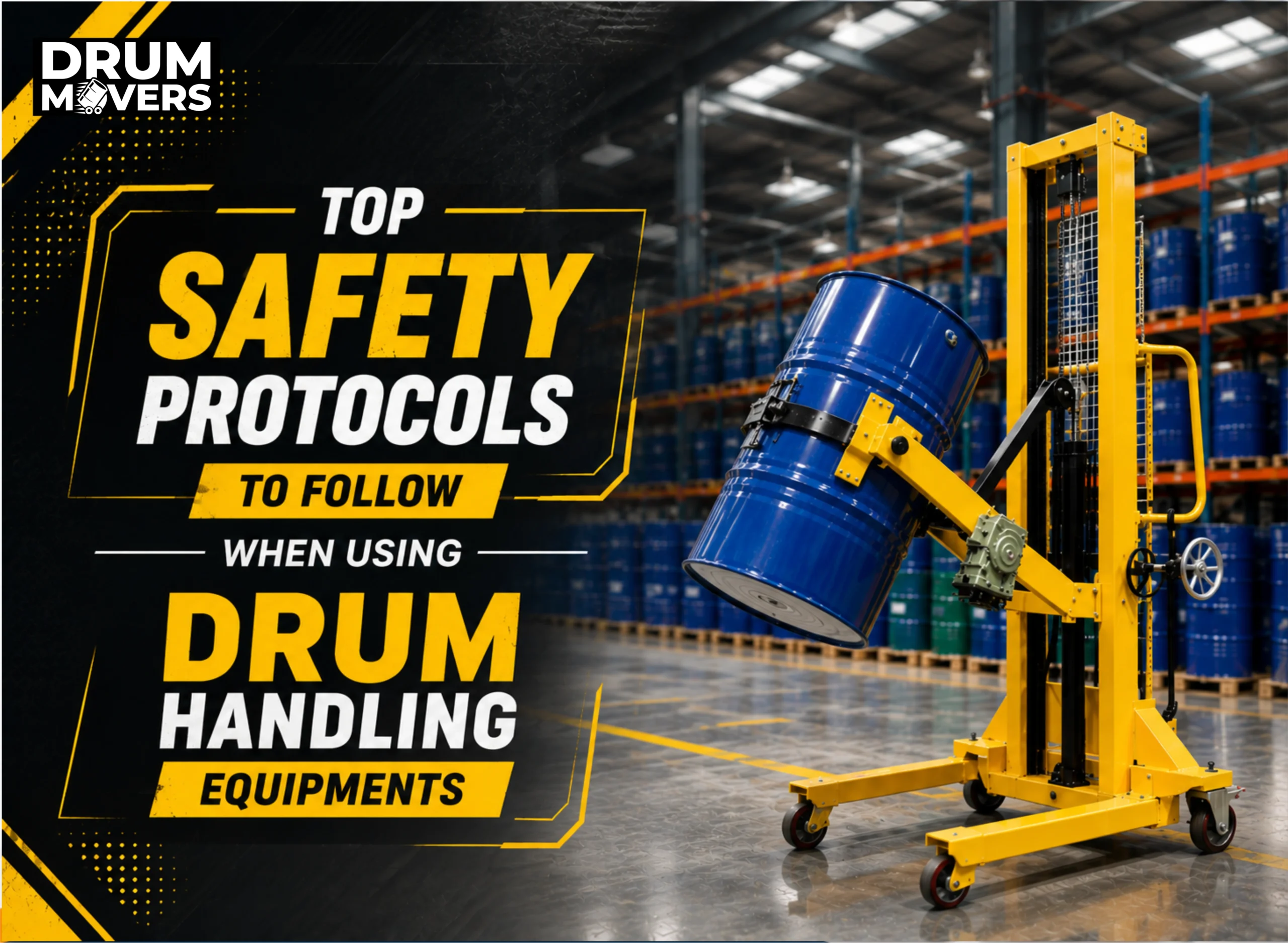
Drums aren’t what we think–they’re heavy objects, especially will weigh hundreds of pounds when filled with contents/materials. So, it is important to provide your employees with the right drum handling equipment to ensure consistent productivity and minimize injuries. In the drum handling business, maintaining the center of gravity is of prime importance.
A short introduction to safe drum handling
It is necessary to distribute drum weight evenly, keeping the drum’s centre of gravity within the equipment’s lifting capacity. Any operation that involves drum handling should see it as non-negotiable to use proper restraints and fastening mechanisms as they’re prone to cause injuries for the workers. It is not only for the worker’s wellbeing, but also to maintain consistency in overall efficiency and productivity. It is well known among industries that improper or unsafe drum handling can cause leaks and spills besides bodily injuries and can contaminate the water and soil sources. Thus, it is a big time requirement to invest in high-quality drum handling equipment.
As the leading drum handling equipment suppliers in the UAE, it’s top priority to us that our customers follow safe practices during drum handling.
Now, let’s look at some of the most important safety tips when it comes to drum handling.
Strict ‘No’ to untrained personnel
It is an essential procedure to oversee who handles what when dealing with cumbersome industrial tools like drums. Every operator should know the drum handler’s allowed capacity, suited drum sizes, security procedures, expected drum hazards and what to do in the event of a spill or leakage. CCOHS clearly emphasizes on the importance of assigning handling to personnel who have had proper training in this, and the general material-handling guidance stresses receiving training before using mechanical aids.
Know your drums before handling them
It is key to recognize the drum you’re going to handle before touching it. Reading the label, matching it to the SDS and confirming whether the contents inside are flammable, corrosive, toxic, reactive or unknown also falls under must-do preparations. It is advised not to rely on memory or assumptions while you’re confused whether the drums contain waste or residue.
Inspect drums before moving them
The third protection tip is to conduct thorough inspection on drums before moving them. There are various signs seen on drums that are considered red flags: corrosion, dents, leaks, damaged chimes, missing closures, swelling or bulging. Building drums being the most crucial emergencies, OSHA emphasizes that until the cause is figured out and protective measures taken, a drum is not to be moved. It goes the same way in the case of degraded drums as well, as their shell or top may be at risk of failure during lifting or rolling.
Stop improvising; choose the right equipment
While handling drums, people tend to improvise, switching between drum sizes and equipment. This is a very unsafe practice. One should always be choosing the equipment that is compatible for the drum size, material, and weight. It is a frequently emphasized safety rule that we should use mechanical aid whenever possible, not when we really need it. There are known practices where employees substitute general trolleys with a drum rotator and so on. The whole idea behind high quality drum handling equipment is to minimize manual handling and fully eliminate safety hazards. All the available equipment should be fitness-tested and ready to use according to their capacities.
Containing vapor, splash, dust and skin exposure while transferring
It is of key importance to actively limit splash, dust or skin exposure while opening, filling or emptying drums. Even when drums are properly handled, there still exists the risk of exposure.
NIOSH advises to use mechanical equipment whenever possible and to wear protective gear at all times while handling drums to protect employees from vapor, splashes, dust or skin exposure.
Conclusion
Drum handling is an essential part of industrial operations and it is really important to ensure the safety of both workplaces and personnel. Drums are heavy objects that need active attention while being handled, and unsafe drum handling practices often lead to serious injuries, loss of time and wastage. Choosing the right equipment that matches the drum specifications and knowing what to use and when are crucial in drum handling operations. Having high-quality drum handling equipment tailored for your operational needs thus comes before every other safety measure. At Drummovers, we put prime importance on supplying state-of-the-art drum handling equipment across the GCC as part of ensuring safe handling and efficiency for our customers. We bring together global manufacturers and their world-class products so that customers across the UAE and GCC can scale as much as they want without having to compromise on efficiency and safety